
AS 1940 Explained: Safe Handling of Flammable and Combustible Liquids
Flammable and combustible liquids are common in many workplaces. They include products such as petrol, diesel, solvents, thinners, paints, resins, adhesives, inks, cleaning chemicals, and some laboratory or manufacturing chemicals.
Because these liquids can create fire, explosion, health, environmental, and property risks, they need to be stored and handled with care. In Australia, one of the main technical references used for this is AS 1940 – The storage and handling of flammable and combustible liquids.
This article explains the broad intention of AS 1940.
What is AS 1940?
AS 1940 is an Australian Standard that provides guidance and requirements for the safe storage and handling of flammable and combustible liquids. It helps businesses answer questions such as:
- Where can these liquids be stored?
- How much can be stored?
- What type of storage area or cabinet is needed?
- What type of ventilation is required?
- How should spills be contained?
- What needs to be kept away from ignition sources?
- What signs, equipment, and procedures are needed?
- How can fire and explosion risks be reduced?
- What training and supervision should workers have?
The Standard is commonly used by businesses, consultants, regulators, designers, insurers, and safety professionals when assessing whether a workplace is managing flammable and combustible liquid risks appropriately.
What is the main intention of AS 1940?
The broad intention of AS 1940 is simple:
Keep flammable and combustible liquids stored and handled in a way that prevents fires, protects people, limits spills, and reduces damage if something goes wrong.
It is not just about putting chemicals in a cupboard. It is about considering the whole risk picture, including:
- the type of liquid being stored;
- the quantity being stored;
- the packaging or tank used;
- where the liquids are located;
- ventilation;
- ignition sources;
- spill containment;
- fire protection;
- access and emergency response;
- worker training; and
- compatibility with other chemicals and activities.
What is the difference between flammable and combustible liquids?
A simple way to understand the difference is this:
Flammable liquids give off vapours that can catch fire more easily at normal workplace temperatures. They have a lower Flash Point of ≤60ᴼC c.c. and are divided into packing groups (the lower the flash point, the lower the packing group).
Examples may include petrol, acetone, ethanol, methylated spirits, some solvents, thinners, and certain paints or adhesives.
Combustible liquids can still burn, but they usually need more heat before they give off enough vapour to ignite. They have a higher Flash Point (>60ᴼC c.c.) and are divided into C1 combustible liquids and C2 combustible liquids.
Examples may include diesel, some oils, and certain heavier liquid products.
Both types can create serious risks, especially when stored in larger quantities or used near heat, sparks, electrical equipment, forklifts, vehicles, hot work, static electricity, or poor ventilation.
Why vapour matters
With flammable liquids, the liquid itself is not usually the main issue. The vapour is often the real danger. Flammable vapours can:
- travel away from the container;
- collect in low areas, drains, pits, sumps, or enclosed spaces;
- ignite if they reach a flame, spark, hot surface, or other ignition source;
- flash back to the liquid source; and
- create fire or explosion risks.
This is why AS 1940 places strong emphasis on ventilation, separation from ignition sources, spill control, and appropriate storage design.
Key areas covered by AS 1940
AS 1940 covers a broad range of storage and handling situations. The exact requirements depend on the product, quantity, container type, building layout, and workplace activity. The main areas include the following.
1. Correct identification of the liquid
Before deciding how a liquid should be stored, the business needs to understand what the product is. This normally involves reviewing the Safety Data Sheet, product label, dangerous goods classification, flash point, packing group, and any specific manufacturer storage instructions.
A business should know whether the product is:
- a flammable liquid;
- a combustible liquid;
- a dangerous good;
- a hazardous chemical;
- incompatible with other substances;
- sensitive to heat, sparks, static, or contamination; or
- subject to other storage restrictions.
Good storage decisions start with good product information.
2. Suitable storage location
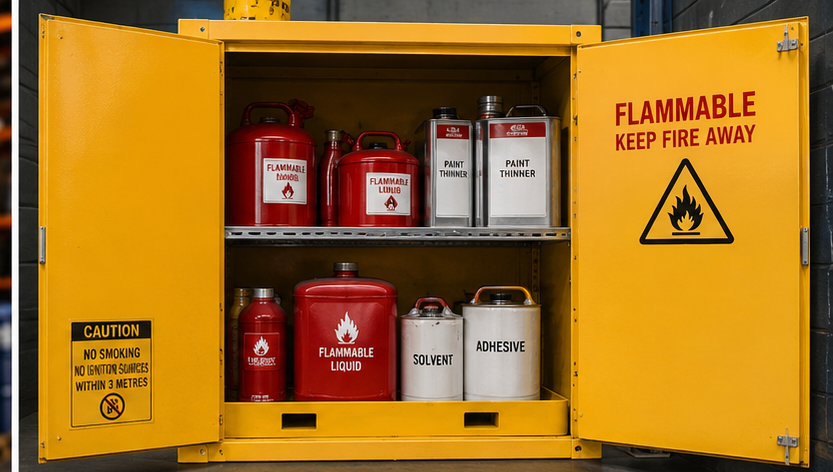
AS 1940 is concerned with where flammable and combustible liquids are stored. The storage location should be selected to reduce risk to people, buildings, neighbouring properties, protected places, drains, ignition sources, and emergency access.
Depending on the quantity and situation, liquids may be stored in:
- minor storage areas;
- flammable liquids cabinets;
- dedicated package stores;
- outdoor storage areas;
- tanks;
- process areas; or
- specially designed storage facilities.
The larger the quantity, the more important the location, construction, separation, spill containment, and emergency controls become.
3. Separation from ignition sources
A core principle of AS 1940 is to keep flammable vapours away from ignition sources. Ignition sources may include:
- flames;
- welding or grinding;
- smoking;
- heaters;
- electrical equipment;
- forklifts and vehicles;
- battery charging areas;
- static electricity;
- hot surfaces;
- pumps and motors;
- switches, power points, and lighting not suitable for the area.
This does not mean every workplace needs complex electrical engineering, but it does mean businesses must think carefully about whether vapours could be present and what could ignite them.
4. Ventilation
Ventilation helps prevent flammable vapours from building up. Poor ventilation can allow vapours to accumulate, especially in enclosed rooms, cabinets, shipping containers, pits, drains, or low points.
AS 1940 expects storage and handling areas to be designed and managed so vapours are controlled. Depending on the situation, this may involve natural ventilation, mechanical ventilation, outdoor storage, or restrictions on decanting and dispensing activities.
5. Spill containment
Flammable and combustible liquids should not be allowed to spread freely if a container leaks or is damaged. Spill containment may include:
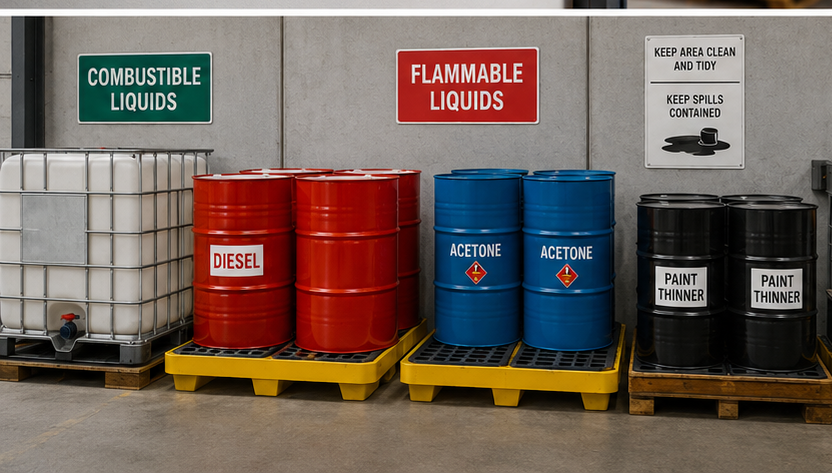
- bunded storage areas;
- spill trays;
- compliant cabinets;
- graded floors;
- containment compounds;
- spill pallets;
- sealed floors;
- drain protection; and
- spill kits.
The aim is to keep spills controlled, prevent liquids from reaching drains or soil, and reduce the chance of a spreading fire.
6. Safe handling and decanting
Many incidents happen not during storage, but during handling. Common handling activities include:
- decanting;
- dispensing;
- mixing;
- transferring from drums;
- filling smaller containers;
- connecting hoses;
- opening packages;
- moving containers by forklift or trolley; and
- disposing of waste liquid.
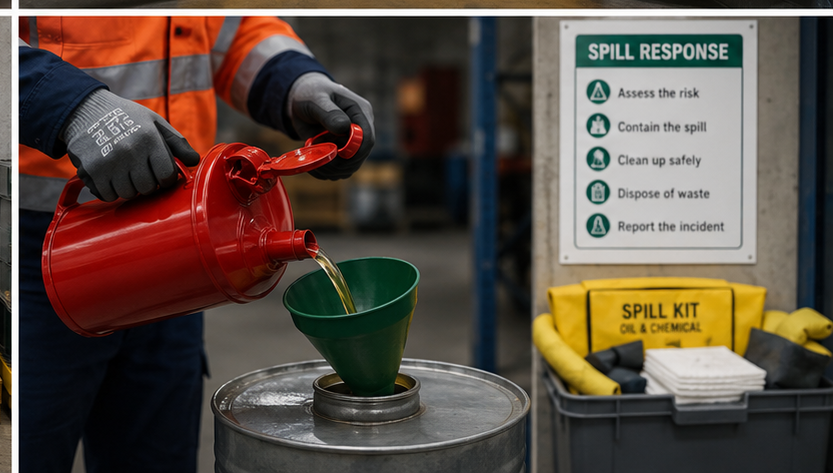
AS 1940 supports controls that reduce spills, vapour release, static discharge, ignition, and worker exposure during these tasks. Practical controls may include suitable dispensing equipment, bonding and earthing where required, drip trays, closed containers, proper funnels, compatible pumps, ventilation, clear procedures, and worker training.
7. Storage cabinets and package stores
For smaller quantities, businesses often use flammable liquids storage cabinets. These cabinets are designed to provide a safer storage option than leaving containers on benches, floors, shelves, or in general storage areas. However, a cabinet must be used correctly. Common problems include:
- overloading the cabinet;
- storing incompatible chemicals together;
- storing items on top of the cabinet;
- leaving doors open;
- keeping damaged or leaking containers inside;
- using the cabinet as a general chemical cupboard;
- placing the cabinet next to ignition sources; or
- using too many cabinets in one area without considering total risk.
For larger quantities, a dedicated package store may be required. This may need additional controls such as fire-rated construction, ventilation, spill containment, separation distances, signage, emergency equipment, and controlled access.
8. Segregation from incompatible substances
Flammable and combustible liquids should not automatically be stored with every other chemical. Some chemicals can react dangerously, increase fire intensity, produce toxic gases, or make an incident harder to control. Particular care is needed with substances such as:
- oxidising agents;
- corrosives;
- organic peroxides;
- toxic substances;
- reactive chemicals;
- gas cylinders; and
- incompatible waste products.
- Combustibles, like fibreboard packaging materials.
Segregation is about keeping chemicals apart when their combination could make a spill, fire, or emergency worse.
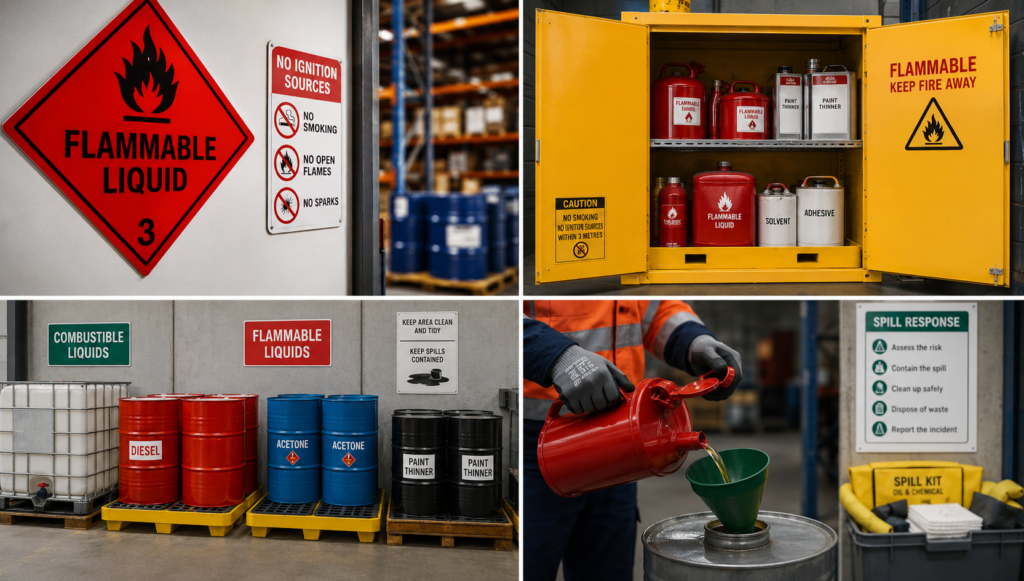
9. Signage and labelling
People need to know what is stored in an area and what precautions are required. AS 1940 supports the use of appropriate signs and markings so workers, visitors, contractors, and emergency responders can quickly identify the presence of flammable or combustible liquids. This may include:
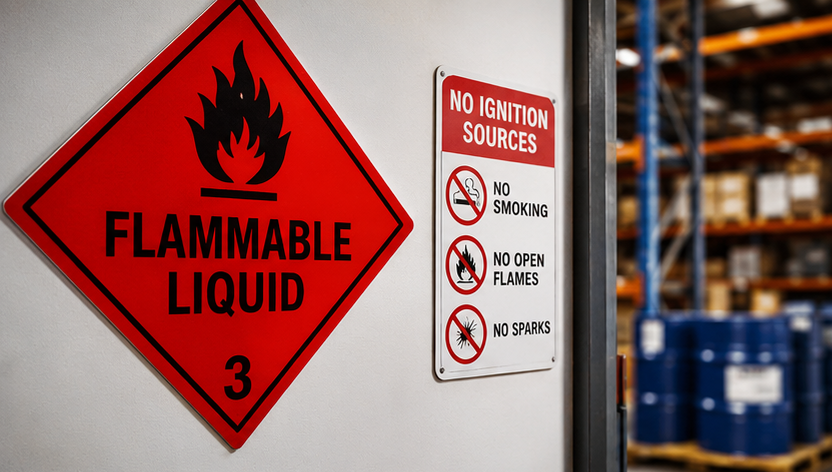
- dangerous goods class labels;
- “Flammable Liquid” signage;
- “No Smoking / No Ignition Sources” signs;
- emergency information;
- placarding where required by WHS legislation;
- tank markings;
- pipe identification; and
- clear product labels.
Signs do not control the risk by themselves, but they are an important part of communication and emergency readiness.
10. Fire protection and emergency preparedness
AS 1940 is concerned with reducing the likelihood of fire and limiting the consequences if a fire occurs. Depending on the site and quantity stored, fire protection and emergency controls may include:
- fire extinguishers;
- hose reels;
- hydrant access;
- fire-rated construction;
- emergency exits;
- clear access for emergency services;
- spill response equipment;
- emergency plans;
- evacuation procedures;
- isolation of ignition sources;
- first aid equipment; and
- worker training.
The controls should match the risk. A small cabinet in a workshop will not have the same requirements as a bulk tank farm or large package store.
11. Housekeeping and maintenance
Good housekeeping is one of the simplest and most effective safety controls. Poor housekeeping can turn a small leak into a serious incident. Businesses should manage:
- damaged containers;
- unlabelled containers;
- open lids;
- chemical residues;
- contaminated rags;
- waste liquids;
- blocked access;
- poor stacking;
- expired or unwanted chemicals;
- dirty bunds;
- spill kit availability; and
- build-up of combustible materials.
Storage areas should be inspected regularly, and problems should be corrected before they become incidents.
12. Training and supervision
Workers who store or handle flammable and combustible liquids need to understand the risks and the workplace controls. Training should be practical and relevant to the tasks being performed. Workers should understand:
- what products they are handling;
- how to read labels and Safety Data Sheets;
- where products may be stored;
- what quantities are allowed;
- how to use cabinets or storage areas correctly;
- what to do if there is a spill;
- what ignition sources must be controlled;
- what PPE is required;
- how to report damage, leaks, or unsafe conditions; and
- when not to attempt clean-up.
Training should be supported by procedures, supervision, and periodic review.
Common workplace mistakes
Some common issues ORP Consultancy sees in workplaces include:
- flammable liquids stored in general warehouse racking without proper assessment;
- too many containers stored in a work area;
- flammable liquids stored near battery charging areas or electrical equipment;
- domestic fridges used for flammable liquids;
- poor segregation from oxidisers or corrosives;
- containers left open after use;
- spill pallets used incorrectly or overloaded;
- bunds filled with rainwater or rubbish;
- cabinets overloaded or used for general chemical storage;
- no clear inventory of what is stored;
- workers not trained in spill response;
- old or unwanted chemicals left in storage for years; and
- assuming “small quantities” means “no controls needed”.
These issues are usually fixable, but they need to be identified and managed.
AS 1940 and legal compliance
AS 1940 is not the only document a business needs to consider. Workplaces may also need to comply with WHS legislation, hazardous chemical regulations, dangerous goods requirements, environmental laws, building requirements, fire safety requirements, and insurance conditions.
AS 1940 is often used as a practical benchmark for safe storage and handling, but legal duties will depend on the jurisdiction, workplace, quantity, and activity.
In simple terms: AS 1940 helps explain what good practice looks like, but businesses still need to understand their broader legal obligations.
When should a business review its storage?
A review should be considered when:
- new flammable or combustible liquids are introduced;
- storage quantities increase;
- a new cabinet, store, tank, or process is installed;
- chemicals are moved to a different area;
- decanting or dispensing activities change;
- there is a spill, leak, fire, near miss, or complaint;
- the Safety Data Sheet changes;
- the workplace layout changes;
- an insurer, regulator, landlord, or client raises concerns; or
- storage has not been reviewed for some time.
Regular reviews help businesses stay ahead of risk rather than reacting after an incident.
Practical first steps for businesses
A simple starting point is to ask:
- What flammable and combustible liquids do we have?
- How much do we store?
- Where are they stored?
- Are they near ignition sources?
- Are they stored in suitable cabinets, stores, tanks, or areas?
- Can spills be contained?
- Are incompatible chemicals kept apart?
- Is the area ventilated?
- Are signs and labels clear?
- Do workers know what to do?
These questions will not replace a formal compliance assessment, but they are a useful way to start identifying obvious gaps.
How ORP DG PRO can assist
ORP DG PRO assists businesses with practical, risk-based support for the storage and handling of flammable and combustible liquids. This may include:
- AS 1940 compliance reviews;
- hazardous chemical storage assessments;
- flammable liquids cabinet and package store reviews;
- segregation and compatibility advice;
- spill containment reviews;
- Safety Data Sheet and inventory reviews;
- practical action plans;
- worker training;
- spill response training; and
- support with safe systems of work.
Our approach is to make the requirements understandable and workable, so businesses can improve safety and compliance without unnecessary complexity.
Final message
AS 1940 is about more than ticking a compliance box. It is about preventing fires, controlling vapours, containing spills, protecting workers, and making sure flammable and combustible liquids are stored and handled in a way that matches the risk.
For many businesses, the best place to start is a simple review of what is stored, where it is stored, how it is handled, and whether the current controls are suitable.
When flammable and combustible liquids are managed well, workplaces are safer, incidents are less likely, and businesses are better prepared if something does go wrong.