Chemical Storage and Handling, Dangerous Goods Training, Workplace Chemical Safety
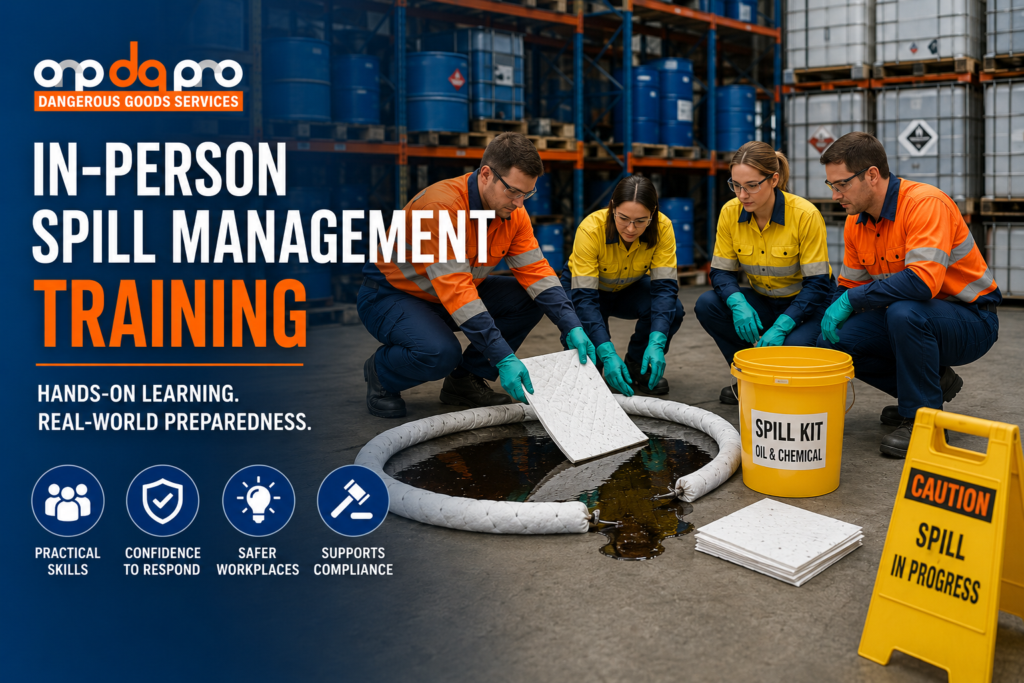
Spill Drills. Why In-Person Spill Management Training Matters
Jun
Spills are one of those workplace incidents that can appear simple at first glance but escalate quickly when people are unsure what to do. A leaking container, dropped bottle, punctured drum, damaged IBC or unknown residue on the floor can create risks to workers, visitors, the environment, stock, equipment and business continuity.
Online training can explain the theory. In-person spill management training goes further. It allows workers to practise the response, handle the equipment, ask practical questions and build confidence before a real incident occurs.
What is spill management training?
Spill management training teaches workers how to recognise, assess, control and report spills involving hazardous chemicals, dangerous goods, oils, fuels or other workplace substances. The training should be matched to the actual workplace, the chemicals handled, the quantities stored and the likely spill scenarios.
A good spill response process usually covers:
- Recognising the substance and the hazard
- Alerting others and notifying supervisors
- Securing the area and preventing exposure
- Assessing whether it is safe to respond
- Selecting suitable PPE and spill equipment
- Containing the spill and preventing spread
- Cleaning up only when safe and authorised
- Disposing of contaminated waste correctly
- Reporting, reviewing and improving controls
The most important message is that not every spill should be cleaned up by local workers. Unknown, large, reactive, vapour-generating, flammable, highly toxic or otherwise unsafe spills should be escalated according to the workplace emergency procedure.
Why in-person training is more effective
1. Workers learn by doing
Spill response is practical work. Workers need to know what a spill kit contains, how absorbents behave, how to place booms or socks, how to prevent liquids entering drains and how to avoid spreading contamination.
In-person training allows participants to physically practise these actions. This helps turn a written procedure into a usable workplace skill.
2. It builds confidence under pressure
During a real spill, people can freeze, rush in without thinking, or make assumptions about the substance involved. A hands-on exercise gives workers a safe opportunity to practise the first decisions:
- Is the area safe?
- Do I know what has spilled?
- Do I have the right PPE?
- Can I stop the source safely?
- Do I clean up, isolate or escalate?
This decision-making is often more important than the clean-up itself.
3. It reveals gaps in the workplace
A practical spill exercise often uncovers issues that are missed during desktop reviews. For example:
- Spill kits are too far away from the storage or handling area
- The kit does not contain the right absorbents or neutralisers
- Workers are unsure who to notify
- PPE is missing, poorly fitted or not suitable for the chemical
- Drain covers are not available
- Waste disposal arrangements are unclear
- Procedures do not match how work is actually done
These findings are valuable because they allow the business to fix weaknesses before an actual incident.
4. It improves teamwork and communication
Spill response is rarely a one-person task. One person may need to isolate the area, another may notify a supervisor, another may check the SDS, and another may bring the spill kit. In-person training helps clarify roles and communication.
This is especially important in warehouses, laboratories, workshops, loading docks, manufacturing areas, chemical stores and transport operations where spills can affect other workers or nearby activities.
5. It supports compliance and due diligence
Businesses that store or handle hazardous chemicals need to provide suitable information, training, instruction and supervision. In-person spill management training helps demonstrate that workers have not only been told what to do, but have had the opportunity to practise safe response actions.
Training records, attendance sheets, exercise notes and post-exercise reviews can also support evidence of due diligence.
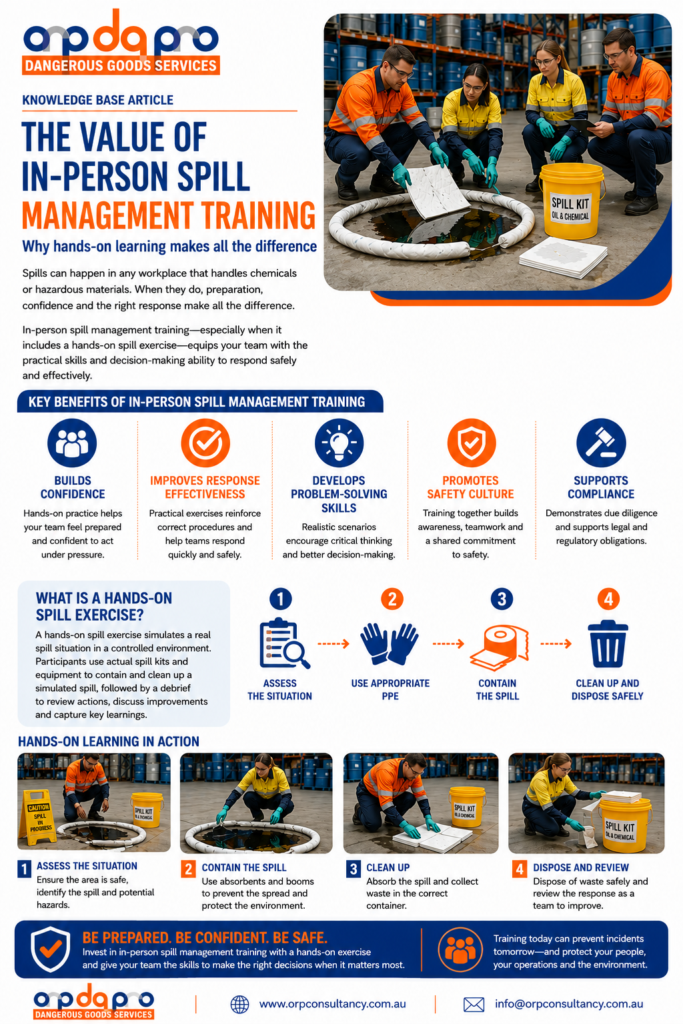
What happens during a hands-on spill exercise?
A hands-on spill exercise is a controlled simulation of a realistic spill scenario. It should use safe training materials such as water or a non-hazardous coloured liquid, rather than actual hazardous chemicals.
A typical exercise may include:
- Scenario briefing
Participants are told what has happened, such as a leaking 20 L drum, a dropped bottle in a laboratory, a punctured container in a warehouse, or a spill near a drain. - Initial response
Workers practise stopping work, warning others, securing the area and deciding whether the spill is safe to approach. - Hazard assessment
The group identifies the substance, checks available information and discusses hazards such as flammability, corrosivity, toxicity, vapour, slip risk and environmental impact. - PPE selection
Participants select suitable PPE for the scenario and discuss the limits of the PPE available. - Containment
The team uses absorbent socks, booms, pads, drain covers or bunding materials to prevent spread and protect drains or sensitive areas. - Clean-up practice
Participants practise applying absorbent material, collecting contaminated absorbent and placing waste into suitable bags or containers. - Waste and decontamination discussion
The trainer explains how contaminated materials should be labelled, stored and disposed of according to workplace procedures. - Debrief and improvement actions
The group reviews what went well, what was unclear and what should be improved in the workplace.
Example spill exercise: leaking container in a warehouse
A practical warehouse scenario may involve a simulated leaking container in a chemical storage or dispatch area. The exercise can test whether workers can:
- Recognise the spill and stop nearby activity
- Prevent forklifts, pedestrians and other workers from entering the area
- Identify whether the product is flammable, corrosive or otherwise hazardous
- Remove ignition sources only if it is safe to do so
- Keep incompatible products away from the spill
- Contain the liquid before it spreads to drains, racking or traffic areas
- Use absorbents correctly without walking through the spill
- Escalate if the spill is outside local response capability
The goal is not to make workers “hazmat responders”. The goal is to ensure they can make safe first decisions, use basic spill equipment correctly where appropriate, and escalate promptly when the spill is beyond their training or equipment.
Who should attend?
In-person spill management training is useful for:
- Warehouse and logistics workers
- Laboratory staff and students
- Production and maintenance workers
- Storepersons and forklift operators
- Supervisors and team leaders
- Cleaners and facilities staff
- Transport and loading dock personnel
- Workers who handle, store or move hazardous chemicals or dangerous goods
Supervisors should be included because they often make the decision to isolate, escalate, stop work, contact emergency services or initiate the incident reporting process.
How often should spill training be refreshed?
Spill training should be refreshed when there are changes to chemicals, quantities, storage locations, work processes, spill kits, PPE, emergency procedures or staffing. Practical drills should also be repeated periodically so workers retain confidence and the business can verify that the procedure still works.
A useful approach is to combine formal refresher training with short scenario-based drills throughout the year.
The bottom line
In-person spill management training gives workers more than information. It gives them practical experience, confidence and a better understanding of their workplace risks.
A hands-on spill exercise helps workers practise the critical first steps: stop, think, assess, contain if safe, escalate when needed, clean up correctly and report the incident. For businesses that handle hazardous chemicals or dangerous goods, this is one of the most practical ways to strengthen safety culture and improve real-world readiness.
Call to action
ORP DG PRO provides practical spill management training for workplaces that store, handle or transport hazardous chemicals and dangerous goods. Training can be tailored to laboratories, warehouses, logistics operations, manufacturing sites, chemical stores and mixed-use workplaces.
