
Hazardous Chemical Register vs Manifest: what your business needs
If your business stores or uses hazardous chemicals, you will almost certainly need a hazardous chemical register. Depending on how much you store, you may also need a manifest.
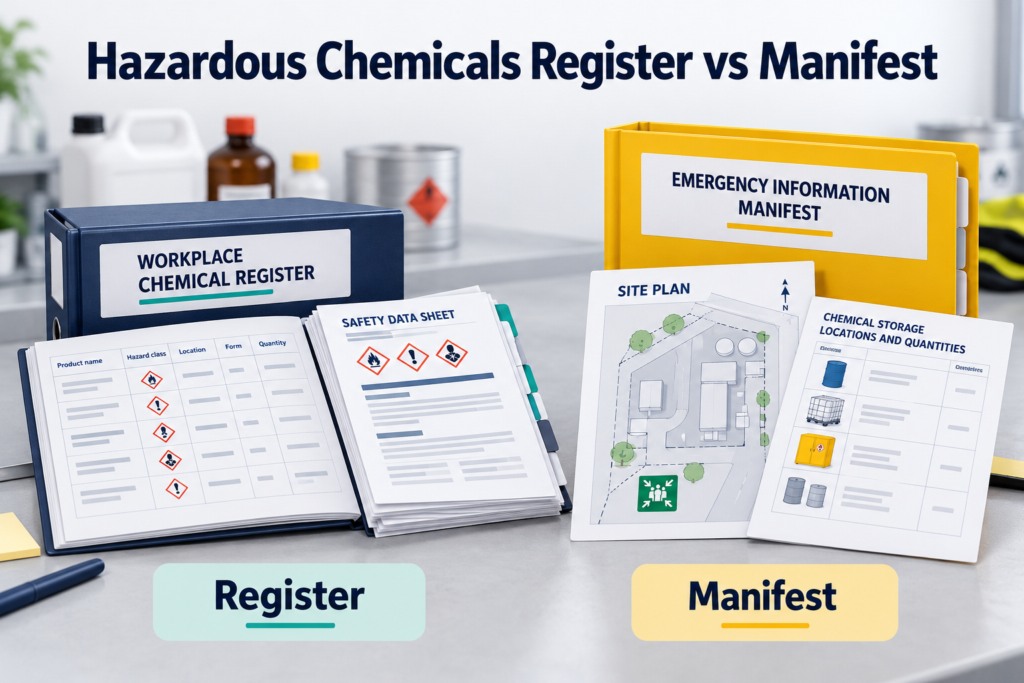
The two documents are often confused, but they serve different purposes and are triggered by different things. This article explains what each one is, when you need it and what it must contain.
What is a hazardous chemical register?
A hazardous chemical register is a list of every hazardous chemical used, handled or stored at your workplace, together with its current Safety Data Sheet (SDS). It is required under regulation 346 of the Work Health and Safety (WHS) Regulation (QLD).
Unlike a manifest, there is no quantity threshold. If you have a hazardous chemical on site, it belongs on the register. This includes a single litre of a cleaning chemical or a few aerosol cans.
What the register must include
- a list of the hazardous chemicals at the workplace, using their product names as they appear on the SDS
- the current SDS for each chemical
Many businesses also record the storage location, the approximate quantity and the SDS issue date. These details are not strictly required, but they make the register far more useful for risk management and stock takes.
Keeping the register up to date
You must keep the register current. Add new products when they arrive, remove products you no longer use, and replace any SDS that has been superseded. The register must also be readily accessible to workers and to anyone else who may be affected, such as contractors and emergency services.
What is a hazardous chemical manifest?
A manifest is a more detailed document designed mainly for emergency services. It is required under regulation 347 when the quantity of a hazardous chemical, or a group of hazardous chemicals, exceeds the manifest quantity listed in Schedule 11 of the WHS Regulation (QLD).
If you exceed a manifest quantity, you must also notify the regulator under regulation 348. In Queensland, the regulator is Workplace Health and Safety Queensland (WHSQ).
What the manifest must contain
Schedule 12 sets out the contents of a manifest. In summary, it includes:
- your business name, the site address and the date the manifest was prepared or last amended
- business hours and after-hours contact details for at least two people responsible for the site
- each storage area and the hazardous chemicals and maximum quantities held there, including tank details where relevant
- a scaled site plan showing storage areas, entrances, drains, fire services, isolation points, the manifest location and adjoining land uses
The manifest is usually kept in a weatherproof box near the main entrance so emergency services can find it quickly.
Register vs Manifest at a glance
| Register | Manifest | |
| Regulation (QLD WHS Regs) | 346 | 347 and schedule 12 |
| Triggered by | Any hazardous chemical on site | Exceeding schedule 11 manifest quantity |
| Main audience | Workers and the business | Emergency services and the regulator |
| Regulator notification | Not required | Required (regulation 348) |
| Includes a site plan | No | Yes |
Common mistakes we see
- SDSs that are more than five years old, or from overseas suppliers without Australian details
- Products on the shelf that are missing from the register
- Businesses that have grown past the placard or manifest quantity without realising it
- Site plans in the manifest that no longer match the layout of the site
Frequently asked questions
Yes. The register has no minimum quantity. It covers every hazardous chemical at the workplace. A limited exemption applies to consumer products used in household quantities and in a household way.
Classify each chemical from its SDS, total the quantities in each category, and compare the totals with the manifest quantities in Schedule 11. Mixed categories have their own aggregate rules, so this is where many businesses get caught out.
Yes, as long as workers and others who need it can readily access it, including during a power or network outage.
Also check out these articles:
The need for chemical storage and handling consult!
Dangerous Goods Storage and Handling: your guide to compliance in Australia
Not sure where your business stands?
Our Hazardous Chemical Storage Health Check gives small and medium businesses an independent site review for a fixed price. You receive a written report that links every observation to the regulatory requirement and sets out prioritised actions to improve compliance.